Overview
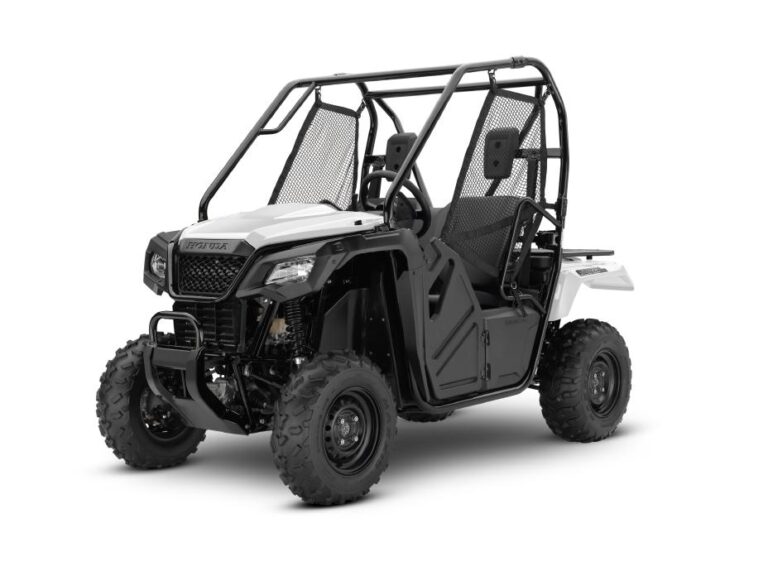
Most utility side-by-sides in the $9,000 range cater to recreational users and light work tasks, but the 2020 Honda Pioneer 500 distinguishes itself with a compact design and approachable functionality that appeal to a broad spectrum of owners. Built for trail riding, farm chores, and general outdoor activities, it combines simple operation with a user-friendly footprint that makes it accessible to novice drivers and seasoned enthusiasts alike.
The Pioneer 500 features a 475 cc single-cylinder liquid-cooled engine with fuel injection, delivering enough power for most light-duty tasks while maintaining simplicity and ease of maintenance. Its manual transmission with an automatic clutch and selectable four-wheel drive system allows for flexible driving modes across different terrains, emphasizing control and adaptability. With an overall length of 8.55 inches and an 8.5-inch ground clearance, it’s suited for navigating tight trails and uneven ground without sacrificing stability.
Designed with a focus on practicality, the machine’s independent double wishbone suspension with 5.9 inches of travel in both the front and rear provides a smooth ride over rough surfaces. Dual hydraulic disc brakes in the front and hydraulic discs at the rear ensure confident stopping power, complementing its compact dimensions and high ground clearance. Targeted at outdoor enthusiasts, light-duty landowners, and small business operators, this model offers a balanced mix of capability and manageable size, with a notable appeal rooted in its simple engineering and Honda’s reputation for reliability.
Performance & Powertrain
Pull up the throttle and the 475cc single-cylinder engine in the Honda Pioneer 500 delivers steady, manageable power suited for trail work and light utility tasks. Its liquid cooling system helps maintain consistent operating temperatures during extended use, ensuring reliability in demanding environments. Fuel injection enhances throttle response and efficiency, providing consistent performance across a range of conditions.
This engine’s output is modest yet well-matched to the machine’s overall weight and intended purpose. The Pioneer 500 isn’t built for high-speed performance but rather for low-end torque and smooth power delivery, which makes it effective for hauling gear or navigating tight trails. The power feels linear, with predictable throttle response that benefits operators who prefer precise control rather than raw speed.
The transmission options include a manual clutch and an automatic clutch, allowing operators to choose between direct control or simplified operation. The drivetrain offers selectable 4X2 and 4X4 modes, giving the rider flexibility for different terrains and load conditions. These systems support effective power distribution to the wheels, assisting in low-traction situations without overly complicating the riding experience.
Suspension & Handling
Working a full day on rough terrain puts the suspension components of the Honda Pioneer 500 to the test. Both front and rear utilize independent double wishbone setups, with each end offering 5.9 inches of travel. This level of suspension travel provides a balanced compromise, absorbing shocks on uneven trails while maintaining stability on hardpack surfaces. The 5.9-inch travel range is typical for utility UTVs in this class, allowing it to handle rocky paths and loose dirt without excessive bounce or loss of control.
The independent double wishbone configuration features separate control arms that allow each wheel to move independently, reducing chassis pitch and enhancing ride comfort. On rocky or rutted trails, this setup maintains tire contact with the ground, improving traction and rider confidence. For work terrain, the suspension’s damping ability prevents excessive jarring when hauling cargo or navigating uneven ground, ensuring stability and rider comfort during prolonged use.
Brake choices complement the suspension’s performance, with dual hydraulic disc brakes up front providing strong stopping power and fade resistance during extended descents. The rear hydraulic disc brake further enhances braking consistency across a variety of terrains. Paired with Maxxis tires-24 x 8-12 at the front and 24 x 10-12 at the rear-these systems deliver adequate grip for trail riding and work applications. The larger rear tires offer increased traction in loose dirt or mud, while the front tires maintain precise steering control on hardpacked surfaces. the combination of suspension, brakes, and tires ensures predictable handling and durability across diverse off-road conditions.
Dimensions & Ergonomics
If you’re planning to load the Honda Pioneer 500 into a standard truck bed, you’ll want to know that its overall length measures just 8.55 feet, making it compact enough for most pickup beds with minimal overhang. Its width of 8 inches may seem narrow at first glance, but this dimension contributes to the vehicle’s agility and maneuverability in tight spaces, while still offering stability during operation. The height of 71.3 inches positions the Pioneer 500 as a relatively low-profile vehicle, which can help reduce wind resistance and improve ease of storage in overhead compartments or garages.
The wheelbase extends to 73 inches, which influences both ride comfort and handling precision. A longer wheelbase generally affords better stability at higher speeds and when traversing uneven terrain, while still maintaining responsiveness suitable for off-road work. Ground clearance of 8.5 inches allows the vehicle to clear most obstacles encountered in trail or worksite environments without risking undercarriage contact, supporting a wide range of outdoor tasks and rougher surfaces.
With a fuel capacity of 4.1 gallons, this machine offers sufficient range for extended outings or work shifts without frequent refueling stops, adding to productivity. The seat height is designed to accommodate a broad spectrum of riders, with an accessible height that balances comfort for shorter operators while still providing sufficient support for taller users. these dimensions and ergonomic considerations contribute to a machine that fits well within typical recreational or work-related settings, ensuring both ease of use and effective operation across varied terrains.
Notable Features
What you get here is a set of enhancements that elevate the 2020 Honda Pioneer 500 above the base-trim competition. Key upgrades include a liquid-cooled 475 cc single-cylinder engine with fuel injection, which provides smoother power delivery and easier starting in a variety of conditions. The inclusion of a manual transmission paired with an automatic clutch simplifies operation for drivers seeking precise control, while the selectable 4X2 and 4X4 drive modes offer adaptability across different terrains.
- Enhanced engine cooling system to maintain optimal performance during extended use
- Fuel injection technology for improved throttle response and fuel efficiency
- Manual transmission with automatic clutch for intuitive control and reduced driver fatigue
- Selectable drive modes for optimized traction on various surfaces
While the Pioneer 500 maintains a simple set of features at this price point, these options provide tangible benefits in performance, control, and adaptability, making it a practical choice for users who demand more from their utility UTV without stepping into higher-priced segments.
Pricing & Value
Most utility UTVs in the mid-range segment hover around the $9,000 to $11,000 mark, and at $9,199, the Honda Pioneer 500 positions itself near the lower boundary of this spectrum. This price reflects a machine designed for consumers who prioritize simple functionality and reliable Honda build quality rather than luxury features or extensive customization options. For the segment, it offers a competitive entry point that appeals to new buyers or those seeking a practical workhorse with manageable size and cost.
In Honda’s lineup, the Pioneer 500 functions as an entry-level model within their utility side-by-side range. It sits below the Pioneer 700 and 1000 models, which offer larger engines, more advanced features, and higher payload capacities at increased prices. Moving upward, the Pioneer 700, for instance, typically starts around $11,200, adding more power and refinement. Conversely, stepping below, there are smaller, less purpose-built machines that lack some of the features and durability Honda customers expect. The Pioneer 500’s price strikes a balance, offering a pragmatic approach for users who need a dependable vehicle without paying for premium extras.
Considering the package, the Pioneer 500’s $9,199 MSRP is fair but not aggressive. It reflects Honda’s reputation for reliability and well-built construction rather than flashy features or high-end technology. For buyers seeking a compact, easy-to-maneuver utility vehicle for farm chores, trail riding, or light hauling, this price provides good value given Honda’s durability. However, for those who expect more power or advanced comfort features, the cost quickly escalates with options or models in higher trims. it’s a sensible entry point in the segment, but not necessarily a bargain-its strength lies in Honda’s brand trust and proven engineering rather than exceptional cost savings or feature density.”
Final Thoughts
This is a machine that prioritizes simplicity and ease of use by maintaining a manageable size and weight while offering enough performance for light tasks. Its compact footprint makes it ideal for operators who need a simple utility vehicle for tasks such as yard work, light cargo hauling, or trail riding without the complexity of larger, more powerful UTVs.
The most defining quality of the Honda Pioneer 500 is its approachable design, which emphasizes a low seat height and intuitive handling. These features translate into confidence-inspiring control, especially for new or casual users who value ease of operation over raw power. The limited suspension travel and modest power output, however, mean it does not excel in rough terrain or heavy-duty work situations, and it falls short for those requiring serious hauling capacity or aggressive off-road capability.
Those who seek a simple, user-friendly utility vehicle for occasional tasks and are comfortable with moderate performance should consider the Pioneer 500. Conversely, if your needs include frequent heavy-duty hauling, aggressive terrain traversal, or extended use over rugged conditions, looking toward larger, more powerful UTVs with stronger suspension and higher payload ratings would be advisable. This machine excels for owners prioritizing maneuverability and low-maintenance operation over brute strength or extensive feature sets.