Overview
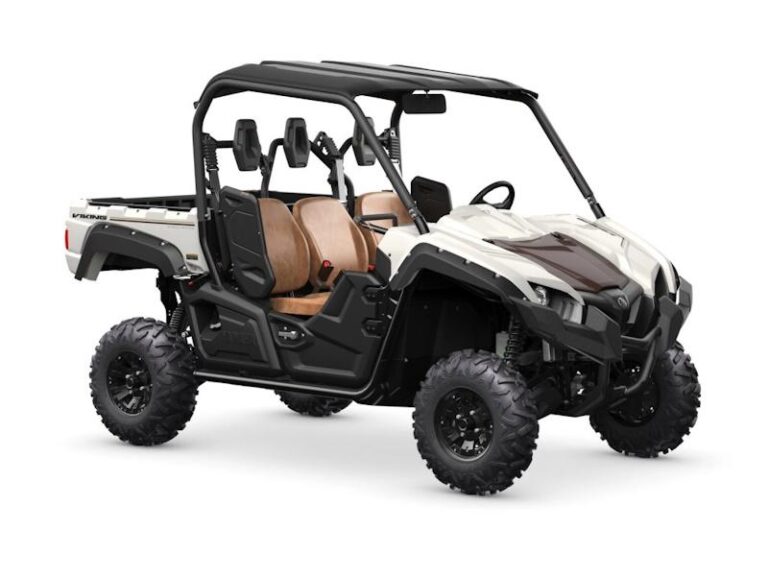
What stands out here is the Yamaha Viking’s focus on delivering a practical utility vehicle aimed at work-oriented users who need a reliable, simple machine for demanding tasks. Built to excel in farm environments, construction sites, or large property management, this machine emphasizes durability, ease of operation, and functional design. Its single-cylinder 686 cc liquid-cooled engine with fuel injection provides a balanced mix of power and efficiency suitable for extended day-long use without unnecessary complexity.
This model employs a continuously variable transmission (CVT) paired with a selectable four-wheel drive system, allowing users to adapt to changing terrains and load conditions with simple toggles. The CVT ensures smooth acceleration and operation, minimizing driver fatigue during long hours of work, while the 4X2 / 4X4 options give the flexibility to switch between traction modes depending on the environment. Its suspension layout, featuring independent double wishbones at both ends with 8.1 inches of travel, strikes a compromise between ride comfort and stability over uneven ground, making it suited for rough terrain without sacrificing too much ground clearance.
Design-wise, the Viking is built with durability in mind-dual hydraulic disc brakes at both ends ensure consistent stopping power, and the relatively broad tires (AT25 X 8-12 up front and AT25 X 10-12 in the rear) provide stability and traction. Its dimensions suggest a compact footprint, with a wheelbase of 84.1 inches and ground clearance of nearly 12 inches, making it maneuverable in tight spaces yet built to handle rough surfaces. this machine positions itself as a dependable workhorse within the utility side-by-side segment, notable for its simple engineering choices and targeted feature set for demanding work environments.
Performance & Powertrain
Pull up the throttle and the 686cc single-cylinder engine delivers a broad range of torque, suitable for tasks from hauling loads to navigating uneven terrain. Its liquid cooling system manages heat effectively during extended periods of work, maintaining consistent performance without overheating. Fuel injection ensures reliable startup and smooth throttle response across varying conditions, making it suited for both work and recreational use where predictable power delivery is essential.
The single-cylinder layout emphasizes simplicity and durability, reducing maintenance complexity while offering enough power for typical utility tasks. While the displacement is modest compared to larger engines in the utility segment, the design prioritizes low-end torque rather than high-revving horsepower. This results in a responsive feel during low-speed operation, ideal for pushing through mud, hauling supplies, or steady towing without abrupt surges or lag.
The transmission employs a continuously variable (CVT) system, which adjusts smoothly to engine load and rider input, ensuring a smooth, continuous power flow. This setup minimizes driver fatigue during long shifts or extended trail runs, as it eliminates gear shifts altogether. The drive system’s selectable 4X2 or 4X4 modes provide flexibility to adapt to terrain demands, allowing the operator to switch between two-wheel and four-wheel drive as conditions change, optimizing traction and stability without complicated interfaces.
Suspension & Handling
If you’re planning to navigate a mix of trail, hardpack, and work terrain, you’ll want to know how this vehicle manages suspension and braking. The Viking’s independent double wishbone suspension setup on both front and rear axles features 8.1 inches of travel in each, which strikes a practical balance. This amount of suspension travel provides enough flexibility to absorb bumps and uneven surfaces typically encountered in off-road environments while maintaining stability on firmer ground. For trail riding, this helps keep tires in contact with the surface, improving grip and control, especially when negotiating rocky or rutted sections. On hardpack or smoother surfaces, the travel allows for comfortable cruising without excessive body roll or suspension bottoming.
The dual hydraulic disc brakes on both the front and rear wheels are a deliberate choice for ensuring strong, consistent stopping power across a range of conditions. Hydraulic discs respond more precisely to pedal input and can dissipate heat more effectively during prolonged braking, which is advantageous on steep descents or when towing heavy loads. The front tires feature 25-inch by 8-inch dimensions, while the rear tires are 25-inch by 10-inch, giving the machine a stable footprint. These tires are designed with an aggressive tread pattern suitable for off-road traction, but they also perform reasonably well on hardpacked surfaces, providing grip without excessive vibration or noise. Their size and tread design optimize the balance between off-road capability and on-road comfort, which is crucial for a utility vehicle intended to handle multiple terrain types.
the suspension system’s travel and the choice of tire dimensions reflect a focus on off-road versatility rather than aggressive racing or heavy-duty hauling. The combination aims to deliver confidence over varied surfaces, with braking components calibrated to respond reliably in diverse environments. This setup favors predictable handling and effective stopping power, making it suitable for work tasks, trail exploration, or general utility use across different terrains.
Dimensions & Ergonomics
If you’re planning to load this side-by-side into a standard pickup truck bed, you’ll want to know that its length measures 122.1 inches and it has a width of 61.8 inches. These dimensions make it manageable for transport and storage without requiring a specialized trailer or oversized equipment. The height of 75.8 inches provides ample cab clearance for most users without feeling overly tall or awkward to handle during mounting and dismounting.
The wheelbase spans 84.1 inches, which contributes to stability during rough terrain or uneven surfaces. A longer wheelbase generally improves ride comfort and directional stability but can slightly reduce maneuverability in tight spaces. Ground clearance sits at 11.8 inches, allowing the vehicle to traverse obstacles like rocks or roots without dragging underneath, a key feature for outdoor work or trail riding. The overall design balances ground clearance with a manageable height for a broad range of rider sizes.
The Yamaha Viking’s dry weight is set at an approximate 1,400 pounds, which supports a payload capacity suitable for hauling gear or supplies. Its fuel capacity of 9.7 gallons offers a reasonable range for extended off-road excursions or workday operations, reducing the need for frequent refueling stops. The seat height, though not specified here, is generally designed to accommodate a wide spectrum of rider statures, with ergonomic considerations that promote comfort during long hours in the vehicle. This combination of dimensions and ergonomic features aims to enhance usability across various tasks and rider preferences.
Notable Features
Anyone running demanding work tasks or engaging in trail adventures will appreciate the enhancements this model offers over base-trim competitors. One of the most significant upgrades is the addition of an electronic fuel injection system, which improves throttle response and overall fuel efficiency-crucial factors for prolonged use in remote environments.
Another key feature is the selectable four-wheel drive system, allowing operators to switch between 4X2 and 4X4 modes without stopping. This flexibility enhances traction on slippery or uneven terrain, making the vehicle adaptable to a wider range of conditions. The simplicity of the CVT transmission provides smooth acceleration and easy operation, reducing driver fatigue during extended workdays or extended trail rides.
While the base model maintains basic comfort and utility focus, Yamaha has introduced practical touches such as a reinforced cargo bed with tie-down points for securing equipment, and a redesigned dashboard layout that improves accessibility to controls and gauges. These improvements increase operational efficiency and safety, especially when handling heavy loads or navigating challenging landscapes.
these features reflect Yamaha’s approach to balancing rugged utility with user-friendly technology, giving this model an edge over less equipped counterparts in its class. The combination of fuel injection, selectable drivetrain, and ergonomic design details make it a dependable choice for those who demand both performance and convenience in their utility vehicle.
Pricing & Value
Among utility ATVs priced around $12,000, the Yamaha Viking Base positions itself as an accessible entry point into Yamaha’s lineup for work-oriented tasks. With an MSRP of $11,999, it targets customers seeking a dependable, no-frills vehicle for farm chores, hunting, or trail work without the premium tags of higher trim levels. Yamaha’s pricing reflects its focus on simplicity and durability rather than luxury features or advanced electronics, aiming to attract budget-conscious buyers who prioritize function over frills.
Placed in the entry-level to mid-range segment, the Viking Base offers a substantial package for its price. It omits the more refined or feature-rich configurations found on additional trim levels but still provides a heavy-duty chassis and proven powertrain. Compared to Yamaha’s higher trims, which incorporate added electronics, comfort amenities, and customization options, the base model keeps costs down by simplifying some components, such as basic lighting and a more utilitarian cargo bed. This approach makes it a fair value for those who need a workhorse rather than a leisure-oriented machine.
In Yamaha’s lineup, the Viking Base acts as an affordable, no-nonsense option positioned below the more feature-laden models like the Viking VI or the Crew. While those higher trims include additional seating, upgraded suspension, and improved comfort features, the base model is primarily aimed at users who want a simple ATV with proven durability. It lacks some of the creature comforts and refinement of the upper trims, but the core engineering remains intact, ensuring reliability over many seasons of demanding use.
Considering the price and the intended use, the Yamaha Viking Base offers strong value relative to segment competitors. Its proven Yamaha build quality, combined with the price point, makes it a sensible choice for individuals or small businesses that need a dependable utility ATV without overspending. It’s not overpriced given what it delivers in terms of core utility functions; rather, it strikes a balance between cost and capability, making it a rational purchase for those who want basic, reliable performance.
Final Thoughts
What stands out here is the Yamaha Viking’s focus on durability and practical utility, making it particularly appealing to those who need a dependable workhorse rather than a recreational machine. Its reputation for long-term reliability stems from proven engineering choices, including a heavy-duty frame and proven powertrain components designed to handle daily wear and tear in demanding environments.
This machine is designed for users who prioritize consistent performance and ease of maintenance over sport-oriented features. Its no-frills layout, sturdy construction, and emphasis on functional design make it ideal for farmers, ranchers, or construction crews who require a tool that can withstand extensive use without fuss. The absence of recreational amenities and focus on core utility keep the complexity low, which is a key advantage for work-centric owners.
The most defining quality of the Viking is its emphasis on enduring functionality. The chassis and engine setup reflect Yamaha’s intent to produce a machine that can be relied upon in tough working conditions, rather than chasing after flashy features or high-performance metrics. This single-minded approach to durability and simplicity makes the Viking an excellent choice for those who need a dependable tool above all else.
If your priority is a work-focused utility vehicle that will serve reliably over many years with minimal fuss, the Yamaha Viking is a strong candidate. However, if you are seeking a machine for recreational off-roading or high-speed trail riding, this may not be the right fit. For simple durability and consistent utility, this machine leaves little to be desired.