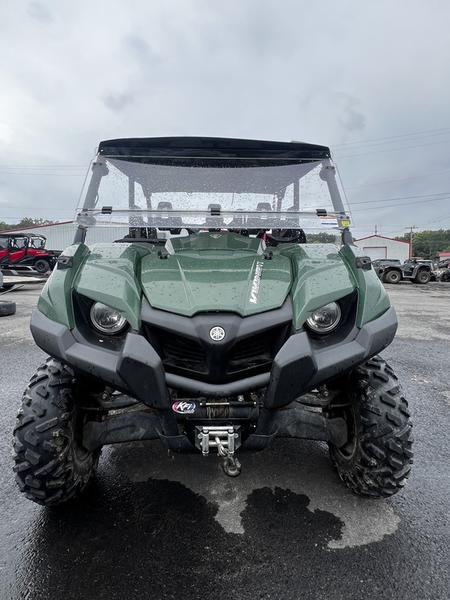
Overview
Riders who need a dependable utility vehicle for work or recreational tasks will find the 2017 Yamaha Viking EPS tailored to handle a variety of terrains and demands. This side-by-side is built around a single-cylinder, liquid-cooled 686cc engine that emphasizes durability and ease of maintenance, making it suitable for outdoor work or farm chores. Its fuel-injected system ensures consistent performance across different conditions, while the CVT transmission offers smooth acceleration without the complexity of manual shifting.
The Viking EPS’s design centers on practicality and user comfort, with an emphasis on stability and control. The independent double wishbone suspension at both ends provides 8.1 inches of travel, allowing it to absorb shocks from uneven terrain and maintain stability during off-road adventures or rough job sites. The vehicle’s dimensions, including a wheelbase of 84.1 inches and ground clearance of 11.8 inches, balance maneuverability with sufficient clearance to navigate obstacles without getting stuck or damaged.
Targeted at outdoor enthusiasts, agricultural workers, and small fleet operators, the Viking EPS offers a simple, functional package that prioritizes reliability and ease of use. Its selectable drivetrain, switchable between 4X2 and 4X4 modes, affords versatility in different work conditions, whether on hard-packed trails or loose, muddy ground. Notable within its segment for its combination of engineered simplicity and adaptability, this model provides a practical option for those who need a workhorse that can also handle occasional recreational rides.
Performance & Powertrain
With 686cc of displacement, the single-cylinder engine provides a balance of torque and responsiveness suited to utility tasks and recreational trail riding. This size is common among utility UTVs in its segment, offering enough power for pulling, hauling, and off-road work without excessive weight or complexity.
The liquid cooling system helps regulate engine temperatures during sustained use, maintaining consistent power delivery even under heavy loads or high ambient temperatures. Fuel injection enhances throttle response and efficiency across a range of operating conditions, reducing fuel consumption and emissions compared to carbureted systems.
The engine is paired with a continuously variable transmission, which eliminates gear shifts and allows for smooth acceleration. This setup simplifies operation, especially in work environments, and adapts smoothly to varying terrain and load demands. The selectable 4×2 or 4×4 driveline allows drivers to switch between two-wheel and four-wheel drive modes, optimizing traction and power distribution based on surface conditions and task requirements.
Power output and transmission choices make this machine suited for hauling, light towing, and navigating rugged trails. The CVT’s design emphasizes ease of use and reliability, while the engine’s displacement delivers enough torque for demanding chores without sacrificing efficiency or maneuverability. this drivetrain setup reflects a focus on practical utility and simple performance in a mid-sized utility UTV.
Suspension & Handling
Working a full day on rugged trail, uneven terrain, or worksite conditions puts the suspension components of this utility UTV to the test. The front and rear use independent double wishbone setups, which are suited for maintaining wheel contact over rough surfaces and absorbing impacts from obstacles like rocks or roots. With 8.1 inches of travel at both ends, the suspension strikes a balance between comfort and control, enabling the vehicle to handle diverse terrain without excessive body roll or loss of stability.
The double wishbone architecture allows each wheel to move independently, optimizing wheel alignment and maximizing tire grip during dynamic maneuvers. This configuration provides the necessary damping for trail riding, where uneven ground demands quick suspension response and stability. On hardpack or smoother surfaces, the travel offers a degree of cushion that reduces driver fatigue, while still supporting the weight transfer needed for steering precision. The equal travel at the front and rear helps maintain predictable handling across different conditions.
The braking system features dual hydraulic disc brakes front and rear, which are chosen for their strong stopping power and heat dissipation. This setup ensures reliable performance when descending slopes or navigating obstacles, where brake fade can limit control. The tires complement this system with sizes of 25 X 8-12 at the front and 25 X 10-12 at the rear, offering a broad contact patch that enhances grip on loose dirt, gravel, or muddy terrain. The combination of suspension, brakes, and tires provides a balanced package that adapts to a variety of work and recreational environments, promoting confidence and control for the operator.
Dimensions & Ergonomics
At 10.17 feet in length, the Yamaha Viking EPS occupies a compact footprint that is suitable for transportation in most pickup truck beds, with enough length to accommodate a crew cab or small cargo if needed. Its 8-inch width provides stability during operation without feeling overly broad for tight turns or narrow trail passages. The vehicle’s height of 75.8 inches ensures sufficient ground clearance while maintaining a manageable profile for storage and maneuverability.
- Wheelbase measures 84.1 inches, promoting stability and predictable handling, especially on uneven terrain
- Ground clearance of 11.8 inches allows for navigating over rocks, roots, and loose debris without excessive risk of bottoming out
- Dry weight of approximately 1,400 pounds contributes to a stable ride, yet remains light enough for easy loading and unloading
- Seat height is designed to fit a wide range of riders, with ergonomic considerations for both shorter and taller users, facilitating comfort during extended use
- Fuel capacity of 9.7 gallons supports longer trail rides and workday durations without frequent refueling stops
These dimensional characteristics influence the Viking EPS’s practical use, making it suitable for tasks ranging from cargo hauling to trail riding. The combination of size and ground clearance strikes a balance between maneuverability and capability, while the ergonomics aim to provide a comfortable experience for riders of various sizes and riding styles.
Notable Features
If you’re planning to spend long hours working or exploring off-road terrain, you’ll want to know how this model differs from base trims or previous years. Yamaha has introduced several enhancements that elevate the Viking EPS beyond entry-level offerings, focusing on comfort, convenience, and control.
- Electric Power Steering (EPS) improves steering effort and reduces driver fatigue, especially on rough trails or extended workdays.
- Selectable four-wheel drive allows for quick switching between 2WD and 4WD modes, optimizing traction and drivetrain efficiency based on terrain demands.
- The liquid-cooled, 686 cc single-cylinder engine delivers consistent power with improved temperature regulation, helping maintain performance during extended use.
- Fuel injection system ensures precise throttle response and better fuel economy compared to carbureted counterparts, particularly in varied operating conditions.
While basic models often omit these amenities, Yamaha has incorporated features that enhance the user experience without significantly raising the price point. The addition of electronic steering and selectable drivetrain modes makes this model more adaptable to different tasks and terrains, providing both comfort and control for the driver. These improvements demonstrate Yamaha’s focus on user-friendly technology intended for active users who value reliability and ease of operation.
Pricing & Value
Among utility side-by-sides priced around $13,000, the Yamaha Viking EPS positions itself as a mid-range offering aimed at users seeking a balance of features and durability without stepping into premium territory. Its MSRP reflects a target market that values Yamaha’s reputation for reliability and ease of use in agricultural, worksite, or recreational settings.
- MSRP of $12,999 places it squarely in the mid-tier of Yamaha’s UTV lineup
- Straddles entry-level models that lack certain comforts and higher-end features
- Offers a more comprehensive feature set than basic workhorse models, but less than premium configurations
- Designed to appeal to users who want more refinement without the high cost of top trims
The Viking EPS’s pricing aligns with Yamaha’s approach to delivering simple, well-engineered utility vehicles with a focus on user-friendly operation and long-term durability. It fits within Yamaha’s lineup as a mid-range option, positioned above basic models like the Yamaha Wolverine and below more luxurious or specialized variants. The trim below this would likely omit electronic power steering and other convenience features, while the trim above might include enhanced seating, climate control, or additional cargo capacity. Considering its price point, the Viking EPS offers a strong ratio of features and quality for the segment, making it a reasonable investment for those who need a dependable work or recreation ATV without paying premium prices.
Final Thoughts
What stands out here is the Yamaha Viking EPS is primarily designed for work-focused users who need a reliable utility vehicle with simple operation and decent payload capacity. Its emphasis on durability and simplicity makes it suitable for ranches, farms, and job sites where ease of maintenance and user-friendly features are priorities.
The defining aspect of this machine is its Electric Power Steering (EPS) system, which enhances maneuverability without adding complexity or weight. This feature improves driver fatigue during long hours of work or traversing challenging terrain, but it also means potential trade-offs in steering feedback compared to more performance-oriented off-road vehicles. For users seeking aggressive handling or high-speed agility, other models with sport-tuned systems might serve better.
While the Viking EPS excels at providing a dependable platform for work and moderate trail use, it falls short for those looking for a high-performance or recreational machine with advanced features like locked differentials, high ground clearance, or aggressive suspension tuning. Its focus on durability and simplicity makes it less adaptable for extreme off-road adventures or utility tasks requiring heavy towing or payloads beyond its design intent.
For buyers prioritizing a simple, dependable utility vehicle with a smooth steering experience for daily chores or light trail work, the Yamaha Viking EPS remains an excellent choice. However, for those who need more aggressive off-road capabilities or specialized features, exploring other options will likely yield better results.