Overview
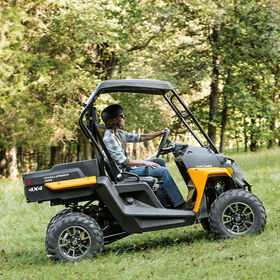
Among utility UTVs priced around $6,000, the 2017 Cub Cadet Challenger 400 offers a simple package aimed at recreational riders and light-duty work applications. It embodies a compact footprint with a focus on affordability and ease of use, making it an attractive option for DIY enthusiasts, farmers, or property owners seeking basic off-road transportation without the complexity of high-end machinery.
This machine features a single-cylinder, 404 cc air-cooled engine combined with a continuously variable transmission and a 4X2 driveline. Its utilitarian design emphasizes simplicity and functionality, with a rigid rear suspension and front double A-arm setup that provides enough travel for small to moderate obstacles. The Challenger 400’s dimensions and ground clearance are optimized for navigating tight trails, farm paths, or construction sites without the bulk or weight of larger models.
The Challenger 400’s character centers on predictable handling and low maintenance. Hydraulic disc brakes up front and drum brakes in the rear offer reliable stopping power, while the modest 940-pound dry weight makes it manageable for a broad range of users. Its modest tire sizes, 21 by 7-10 in the front and 22 by 9-10 in the rear, are designed more for traction and durability than aggressive off-road performance. this model is built for operators who prioritize simple, durable performance in a work- or recreation-oriented utility vehicle, with a notable emphasis on ease of ownership and practical capability within its segment.
Performance & Powertrain
Anyone running utility tasks on rough or uneven terrain will appreciate the 404 cc single-cylinder engine that powers the 2017 Cub Cadet Challenger 400. Its displacement places it roughly in the middle of the segment, providing a balanced mix of torque and fuel efficiency without the extra bulk of larger engines. This configuration tends to deliver responsive throttle feel, making it suitable for tasks such as hauling materials, towing light equipment, or navigating moderate off-road conditions.
The air-cooled design simplifies maintenance and helps keep engine temperatures stable under typical work cycles, although it can be less effective in extremely hot environments or prolonged heavy-duty use. The carburetor fuel system, while less precise than electronic fuel injection, contributes to a lower initial cost and easier servicing, but may require periodic tuning to maintain optimal power delivery. The engine’s power output is modest but adequate for a machine in this class, offering steady acceleration and predictable throttle response during work tasks.
The CVT transmission helps smooth out power delivery by continuously adjusting gear ratios, removing the need for shifting and allowing the rider to focus on steering and task management. This system provides seamless acceleration from a standstill to cruising speeds, although it can generate some belt noise and may not be as responsive as manual transmissions in high-performance applications. The 4X2 driveline simplifies drivetrain layout and reduces mechanical complexity, making it suited for owners who primarily operate on less demanding terrains or with light towing needs. this engine and drivetrain combo delivers a dependable powertrain that balances ease of use with sufficient capability for routine utility tasks.
Suspension & Handling
Pull up the throttle and this machine’s suspension setup begins to show its balance between comfort and capability. The front suspension employs a double A-arm design with 5 inches of travel, allowing for decent wheel articulation which helps maintain contact with uneven terrain. This type of setup is common in utility vehicles aimed at off-road work and trail riding, providing predictable handling while absorbing bumps effectively. The rigid rear suspension, also with 5 inches of travel, offers durability and fewer moving parts, which simplifies maintenance and reduces potential failure points on rugged work sites.
- Double A-arm front suspension provides independent movement for each wheel, improving stability over rocks and ruts.
- 5 inches of front and rear travel strikes a compromise between off-road capability and on-road comfort, suitable for trail riding and light utility work.
- Rigid rear suspension enhances durability for hauling tasks, where fewer moving components reduce potential failure points.
- Braking system features hydraulic disc brakes at the front, delivering strong stopping power and heat dissipation during prolonged use.
- Rear drums, while simpler and less expensive, require periodic adjustments but suffice for the vehicle’s intended utility and moderate speeds.
The tire choices complement the suspension design, with 21 x 7-10 front tires and 22 x 9-10 rear tires. These sizes provide a balance between traction and ride quality on various terrains. The wider rear tires improve grip when carrying loads or navigating loose or uneven surfaces, while the slightly narrower front tires contribute to maneuverability and steering precision. Combined, the suspension and tires enable this vehicle to handle mixed terrain conditions effectively, from rocky trails to packed dirt and work sites, without sacrificing durability or comfort.
Dimensions & Ergonomics
If you’re planning to transport the Challenger 400 in a standard pickup bed, you’ll notice right away that its overall length of 8 feet and width of 7 feet make it manageable while still providing ample cabin space. Its wheelbase, measuring 64 inches, offers a stable footprint that enhances handling on uneven terrain without feeling overly broad or cumbersome. This length and width combination typically allows it to fit within the bed of most full-size trucks, making it simple to tow or transport as needed.
The vehicle’s height of 71 inches places it within a comfortable range for avoiding low-hanging branches and obstacles while maintaining a low center of gravity for improved stability. Ground clearance of 5.5 inches balances off-road capability with ease of access over rough terrain, reducing the risk of getting hung up on rocks or debris. The dry weight of 940 pounds means it isn’t excessively heavy, enabling easier loading and unloading, especially if you plan to move it frequently between work sites or storage locations.
Rider ergonomics are addressed with a seat height designed to accommodate a broad range of users, providing enough elevation for visibility without sacrificing comfort for shorter drivers. The 5-gallon fuel tank supports extended use without excessive weight, and its size allows for ergonomic placement of controls and access to cargo space, which is crucial for utility tasks. Despite its size, the Challenger 400 maintains a compact profile, ensuring ease of maneuvering around tight trails or work zones, while enough cargo room and ground clearance enable it to handle a variety of field and farm environments with confidence.
Notable Features
What stands out here is the inclusion of a 404 cc single-cylinder engine paired with an air cooling system, which is quite typical for utility UTVs in this price range but still offers a decent balance of power and simplicity. This engine design favors ease of maintenance and durability, especially in off-road conditions where minimal complexity can make a significant difference during field repairs or routine service. While not groundbreaking, it demonstrates a practical approach to utility vehicle engineering, emphasizing reliability over high performance.
The interesting choice made by Cub Cadet was equipping this model with a Continuously Variable Transmission (CVT). This transmission type removes the need for driver interaction with gear shifts, providing a smooth acceleration curve and easy operation, especially beneficial for users focused on work tasks or recreational trail riding. The CVT’s ability to adapt to varying terrain and load conditions helps maintain consistent torque delivery, making the vehicle more user-friendly for those unfamiliar with manual shifting or for operators who prioritize simple operation.
Additional features that elevate this model beyond basic utility offerings include a 4X2 driveline, which reduces mechanical complexity and cost while still providing sufficient traction for many light-duty tasks and recreational uses. The absence of 4WD reduces weight and potential maintenance points, but it also limits off-road capability in challenging terrain. This choice reflects a design priority towards affordability and ease of use, catering to casual users and property owners who need a reliable work companion without the added expense of more advanced drivetrain systems.
While the Challenger 400 doesn’t pack a long list of luxury features, it does include standard accessories such as a functional cargo bed and ergonomic controls tailored for everyday utility. The focus remains on delivering a simple machine that performs reliably under common conditions, making it a sensible choice for those who value simplicity and affordability over high-end technical specs. Its combination of basic but effective features ensures it remains competitive within its segment, especially for users who prefer a no-frills approach to their utility tasks.
Pricing & Value
Most utility UTVs in the mid-range segment offer a balance between affordability and functional features – this one, the 2017 Cub Cadet Challenger 400, with an MSRP of $5,999, falls squarely into that category. Compared to other machines in the same class, it aims to attract buyers seeking reliable performance without the premium price tag often associated with higher-end models. Its position within Cub Cadet’s lineup places it as an entry to mid-level offering, bridging the gap between lightweight, budget-focused UTVs and more comprehensive, feature-rich options.
At this price point, the Challenger 400 delivers a package that emphasizes core utility functions. It does not include some of the advanced creature comforts or optional upgrades found on more expensive models, such as enhanced suspension systems, electronic power steering, or high-capacity cargo beds. Yet, it offers a no-frills design that prioritizes durability and practicality-attributes that resonate with buyers looking for a dependable workhorse rather than a luxury ride. Its price-to-value ratio is solid for consumers who need a machine designed for performing basic hauling, towing, and trail work without breaking the bank.
When comparing the Challenger 400 to higher trims or rivals priced above $6,000, the step up often comes with additional features or refined ergonomics rather than a dramatic overhaul of core capabilities. Conversely, models priced below $5,000 tend to cut corners on suspension or engine options, which can compromise long-term durability. In this light, the Challenger 400 strikes a reasonable balance: it’s fairly priced for its segment, offering a dependable platform that’s suitable for both work and light recreational use. Its value proposition is clear-if you’re seeking a basic, rugged utility vehicle without paying for extras you don’t need, this machine justifies its cost.
Final Thoughts
If you’re planning to tackle light farm work, trail riding, or hauling gear around your property, you’ll notice right away that the 2017 Cub Cadet Challenger 400 offers a simple compromise between performance and affordability. It’s best suited for casual users who prioritize ease of use and reliability over cutting-edge features or high-grade suspension systems. This machine is designed to handle tasks in well-maintained environments where moderate durability and simplicity serve just fine.
The Challenger 400’s most defining trait is its uncomplicated, user-friendly control layout paired with a proven powertrain that emphasizes low maintenance and durability. Its single-cylinder engine delivers enough torque for basic chores without the complexity of larger, more expensive units. But this simplicity also means it lacks the refinement needed for heavy-duty applications or challenging terrain that demands advanced suspension, higher ground clearance, or sophisticated drivetrain components. It’s a machine built for light utility work and recreational riding, not for the demanding needs of professional operators or serious off-road enthusiasts.
Anyone looking for a machine that prioritizes durability in a simple package will find the Challenger 400 to be a reasonable choice. However, those who require a machine with more purpose-built suspension, higher payload capacity, or more refined handling should consider stepping up to a model with more advanced features. For those who want dependable performance with minimal fuss in a recreational or light-duty context, this Cub Cadet model performs as intended and is worth considering.