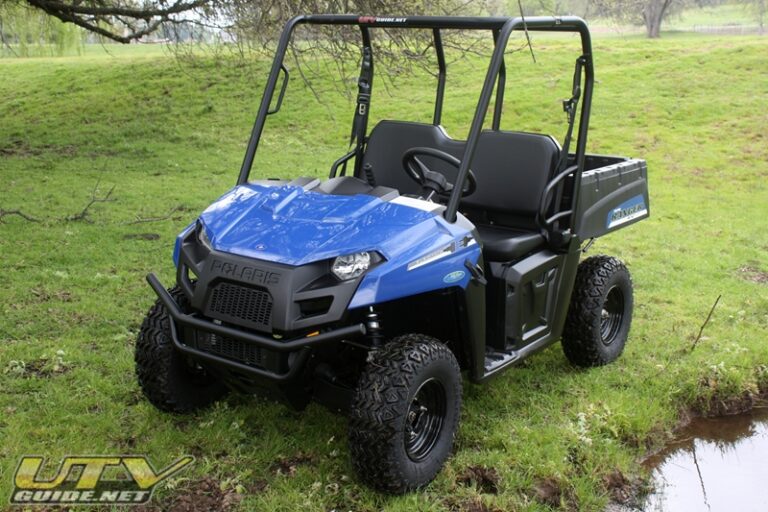
Overview
What stands out here is the Polaris Ranger EV’s focus on clean, quiet operation for work or recreation in environments where emissions and noise matter. This is a utility side-by-side built primarily for users who need a reliable electric vehicle for tasks like farm chores, equipment hauling, or light trail work. Its electric motor eliminates the need for gas, making it suitable for confined spaces or areas with strict emissions regulations, while still providing enough power to handle moderate towing and payload duties.
This model is designed with simplicity and low operating costs in mind. It features an automatic transmission and a selectable drive system that switches between two-wheel drive and all-wheel drive, giving users flexibility on various terrains. The suspension setup with McPherson struts up front and independent double A-arm in the rear offers enough travel for rougher terrain, though it’s not intended for aggressive off-roading. Its ground clearance of 10 inches helps navigate obstacles like rocks and uneven ground without getting stuck, making it suited for farm lanes, trail paths, and light construction sites.
Targeted toward small farm owners, property managers, and outdoor enthusiasts who prioritize low maintenance and a quiet ride, this Ranger EV offers a practical balance of utility and ease of use. Its relatively compact dimensions and low weight of 1700 pounds make it easy to maneuver around tight spaces or transport in a trailer. While it might not match the ruggedness or towing capacity of larger gas-powered UTVs, its notable feature is the electric powertrain that reduces fuel costs and maintenance needs, setting it apart within the utility vehicle segment.
Performance & Powertrain
Anyone running tasks that require quiet operation and minimal maintenance will appreciate the electric motor in this utility UTV. With its 48-volt AC induction motor, the Polaris Ranger EV delivers smooth, instant torque, making it suited for work around farms, large properties, or quiet trail riding.
- Displacement: Electric motor with 48 volts, no combustion engine
- Cooling system: Air-cooled motor that requires minimal upkeep
- Fuel system: Not applicable, as it runs on rechargeable batteries
- Transmission: Automatic with a simple, single-speed drive
- Drive system: Selectable 4X2 or all-wheel drive for different terrains and load conditions
In real-world use, the power delivery feels immediate, with no lag or shifting delays. This makes it ideal for soft terrain, light hauling, or situations where noise and emissions are a concern. While it doesn’t match up to larger, gas-powered engines in raw power, the electric setup offers quiet operation, low running costs, and enough torque to handle moderate inclines and work tasks without breaking a sweat.
Suspension & Handling
If you’re planning to tackle a variety of terrains, you’ll want to know how this machine manages shocks and grip. The front suspension uses a McPherson Strut setup with 8 inches of travel, which helps absorb impacts on uneven trails and provides a smoother ride over rocky surfaces. The rear features independent double A-arms with 9 inches of travel, offering better wheel articulation and stability when crossing rutted or loose terrain. These suspension choices are suited for moderate trail riding, light work, and handling rough patches without requiring frequent adjustments or upgrades.
The braking system employs hydraulic disc brakes on both the front and rear wheels. This setup delivers strong stopping power and consistent feel, which becomes especially useful when descending steep grades or navigating tight turns. Hydraulic discs are less prone to fade during prolonged use compared to drum brakes, making them a dependable choice for work tasks or extended trail runs. The brake design helps maintain control in demanding conditions without excessive pedal effort, adding to safety and confidence while riding or working in rugged environments.
Matching the suspension and brakes are Carlisle tires sized at 25 X 9-12 on both front and rear wheels. These tires strike a balance between grip and durability, with a tread pattern designed for traction on hardpack, dirt, and light mud. The 12-inch wheel diameter offers stability and clearance over obstacles without compromising maneuverability. While these tires perform well on typical trail surfaces and work terrains, they may struggle on very loose or muddy conditions, where deeper tread or specialized tires might be necessary. the suspension, brakes, and tires work together to provide predictable handling and reliable performance in common outdoor scenarios.
Dimensions & Ergonomics
Most utility UTVs in the under $11,000 range measure around 9 feet long and nearly as wide, and this model fits squarely within those common dimensions. Its size makes it manageable for a variety of tasks, from hauling gear in tight spaces to fitting in a standard pickup truck bed for transport between jobs or trails.
- Length: 9 feet (108 inches)
- Width: 9 feet (108 inches)
- Height: 73 inches
- Wheelbase: 72 inches
- Ground clearance: 10 inches
- Dry weight: 1,700 pounds
- Seat height: approximately 36 inches
The 73-inch height offers enough clearance for taller riders without feeling cramped, while the seat height helps shorter drivers maintain comfort and control. The wheelbase of 72 inches contributes to stability during work tasks or on uneven terrain, while ground clearance of 10 inches allows for moderate obstacles without getting hung up. It’s wide enough to feel stable on rough ground but narrow enough to maneuver easily through tighter trails or confined spaces. Its physical size also means it can fit in most standard truck beds, making transportation simple for farm work or trailering to remote locations. The ergonomic seat height gives riders with different statures a comfortable position, reducing fatigue over longer days of use. Combined with the overall dimensions, this UTV is designed to be practical for daily tasks and weekend adventures alike.
Notable Features
What stands out here is the inclusion of an electric powertrain at this price point, which provides a quieter ride and eliminates the need for fuel stops. This model is designed for users who want lower operating costs and reduced emissions, making it suitable for work sites or recreational areas where noise and fumes are concerns.
- Electric motor with instant torque delivery for better responsiveness in low-speed tasks
- Automatic transmission simplifies operation, especially for users unfamiliar with shifting gears
- Selectable 4X2 or all-wheel-drive allows customization based on terrain and load needs
- No fuel system required, reducing maintenance and potential leak concerns
- Built-in features like a simplified dashboard and basic accessories for practical use
While it may lack some of the advanced tech or luxury fixtures found on higher-end models, this model’s focus on electric power and ease of use offers tangible benefits for daily work or moderate trail riding. It’s a machine designed to keep operational costs low while delivering a quiet and clean experience.
Pricing & Value
What stands out here is the Polaris Ranger EV priced at $10,999, positioning it as an entry-level electric utility vehicle aimed at budget-conscious buyers or those transitioning to electric power for work or recreation. This price tag makes it competitive within the electric UTV segment, where other models often come with a premium. Given its electric drivetrain, the Ranger EV offers a quiet, emission-free option that appeals to users prioritizing lower operating costs and reduced noise, especially on farm properties or within noise-sensitive environments.
In terms of the broader Polaris lineup, this model slots below the mid-range and top-tier trims that often include larger engine options or additional luxury features. It functions as a practical entry point for Polaris customers interested in electric power but not wanting to pay for higher-end models with more creature comforts. The $10,999 MSRP reflects a package that trades some range and power for affordability, which will suit many light-duty work scenarios or weekend trail rides where electric power provides sufficient torque and quiet operation.
Compared to other electric or smaller displacement gas-powered UTVs in the same price range, the Polaris Ranger EV generally offers good value. It doesn’t include high-end accessories or extended range options, but it covers the basics well and is backed by Polaris’s reputation for durable off-road machines. For owners who don’t need a heavy-duty workhorse or the maximum range, this model provides an affordable, low-maintenance solution that can handle chores like hauling tools, materials, or light cargo on a daily basis. Its price-to-functionality ratio makes it a sensible choice for those who want to dip into electric power without overpaying.
Final Thoughts
The interesting choice Polaris made was to focus solely on electric power for this utility UTV, making it a quiet, emissions-free option for work or recreation. Its main appeal lies in urban or suburban environments where noise restrictions or air quality concerns are a factor, but it also performs adequately on trail rides with moderate terrain. The absence of a gas engine results in lower operating costs and less maintenance, but it also means limited range compared to traditional internal combustion models.
This machine is best suited for users who prioritize quiet operation, low running costs, and a clean, emissions-free profile. It works well for light farm chores, property maintenance, or neighborhood rides where noise and fumes are undesirable. The single-charge range, typically around 30 miles, restricts longer adventures or heavy-duty hauling, so those needing a workhorse for extended hours might find this machine less practical. Its acceleration is sufficient for low-speed tasks but won’t satisfy those seeking high-speed thrills or rugged trail performance.
The key factor that makes or breaks this purchase is the battery capacity and charging infrastructure. If you plan to use the Polaris Ranger EV for daily work or regular outings, you’ll need to consider how often it can be recharged and whether you have easy access to charging stations. For owners seeking a quiet, low-maintenance utility vehicle for short distances and light loads, this UTV fits well. For anyone needing a long-range, high-utility machine for demanding terrain or extended use, looking at gas-powered alternatives is advisable. This is a machine for specific needs, not a one-size-fits-all solution, and it delivers best when used within its designed purpose.”