Overview
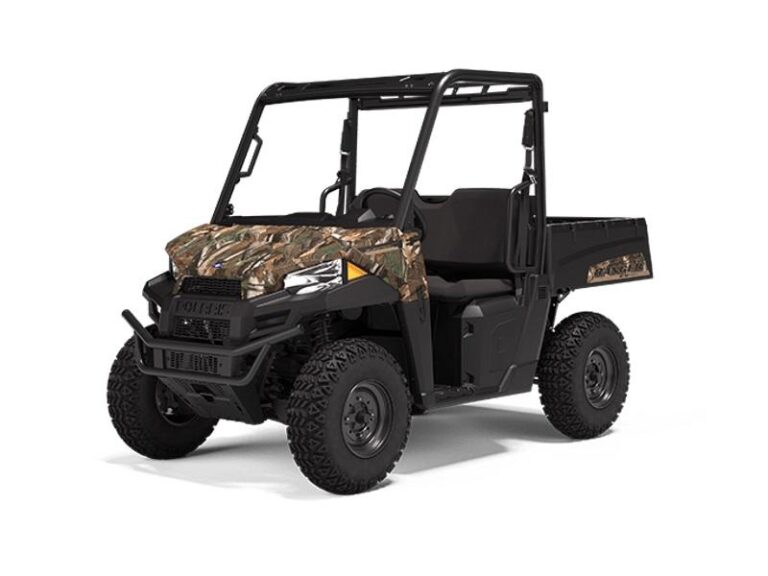
What stands out here is the Polaris Ranger EV’s focus on delivering a practical yet eco-friendly utility vehicle for work and recreational use. This model belongs to the utility side of the UTV segment, designed primarily for users who need a dependable workhorse that minimizes environmental impact without sacrificing functionality. Its electric powertrain eliminates exhaust emissions and reduces noise, making it suitable for quiet operation in sensitive environments or confined spaces.
The Ranger EV’s heavy-duty chassis and suspension setup reflect its purpose: to handle uneven terrain and carry cargo while maintaining stability. The combination of a McPherson strut front suspension with 9 inches of travel and an independent double A-arm rear with 10 inches of travel indicates a design optimized for off-road capability and load comfort. Its 10-inch ground clearance further enhances its ability to navigate challenging terrain, making it suitable for farms, large properties, or maintenance tasks where access to remote or rugged areas is necessary.
This model is targeted at buyers seeking a low-maintenance, emission-free utility vehicle that can serve both work and play. Its relatively modest size, with a length just over 9 feet and a 72-inch wheelbase, allows for maneuverability in tight spaces while still providing enough cargo capacity. The inclusion of selectable four-wheel drive offers added traction for tough conditions, appealing to those who need a machine that adapts to varying terrains and workloads. What makes this model particularly noteworthy within its segment is its integration of electric propulsion with familiar utility features, promising a quieter, cleaner operation without compromising the rugged performance expected from a Polaris Ranger.
Performance & Powertrain
Riders who need a quiet, emissions-free utility vehicle will find the electric powertrain of the 2020 Polaris Ranger EV suited for work environments that demand low noise and zero exhaust fumes. Unlike traditional gas engines, this electric setup provides consistent power delivery without the lag associated with carbureted or throttle-body fuel systems, making it ideal for repetitive tasks like farm chores or maintenance runs.
This level of torque is especially noticeable in low-speed work, where it can handle steep inclines and heavy loads without the need for complex throttle modulation. The absence of a traditional transmission simplifies operation; the direct drive system transfers power without gear shifts, reducing maintenance and potential points of failure. This drivetrain configuration enables smooth, predictable acceleration that stays consistent regardless of load or terrain, making it suited for users prioritizing simple, dependable performance.
The selectable four-wheel drive system further enhances the machine’s utility, allowing operators to toggle between 2WD and all-wheel-drive modes based on terrain demands. In 4WD, torque distribution improves traction on loose gravel or mud, while switching to 2WD conserves energy during less demanding tasks. The direct drive layout eliminates the need for a clutch or transmission fluid changes, which benefits users looking for a low-maintenance vehicle with predictable power delivery. the electric powertrain combines instant torque, simplified mechanical design, and flexible driveline options to support a range of utility applications without the noise, fumes, or complexity of traditional internal combustion engines.
Suspension & Handling
If you’re planning to navigate a mix of trail conditions, hardpacked surfaces, or work site terrain, you’ll want to understand how the Polaris Ranger EV’s suspension setup manages these environments. The front McPherson Strut offers a balance between comfort and control, with 9 inches of travel that helps absorb bumps on uneven ground, while the independent double A-arm rear suspension provides slightly more give with 10 inches of travel. These figures indicate that the vehicle is designed to handle rougher terrain without sacrificing too much stability on smoother surfaces.
- Front suspension: McPherson Strut with 9 inches of travel
- Rear suspension: Independent double A-arm with 10 inches of travel
- Suspension travel enhances comfort on rough trails but raises center of gravity slightly
- Braking system employs hydraulic disc brakes front and rear for consistent stopping power
- Tires: Carlisle All Trail II, 25 x 9-12, providing grip on a variety of terrain types
The 25-inch Carlisle All Trail II tires are a broad profile that offers a solid grip on loose dirt, gravel, and trail debris, while maintaining enough size to help with obstacle clearance. Hydraulic disc brakes on both axles deliver predictable performance, even during prolonged or heavy use, ensuring the vehicle can decelerate reliably in diverse conditions. The combination of suspension travel, tire size, and braking hardware aligns with the Ranger EV’s intended utility role, providing a good balance of comfort, control, and grip across different terrains without overly increasing complexity or weight.
Dimensions & Ergonomics
Most utility UTVs aimed at the recreational or work-oriented market provide a compact footprint that allows for easy transportation and maneuverability. The 2020 Polaris Ranger EV measures 9.17 feet in length and 9 inches in width, making it narrow enough to navigate tight trails or fit into a standard truck bed for transport. Its height of 73 inches and wheelbase of 72 inches contribute to stability without sacrificing agility. The vehicle’s ground clearance of 10 inches supports rough terrain without risking bottoming out.
- Length: 9.17 feet (110 inches)
- Width: 9 inches
- Height: 73 inches
- Wheelbase: 72 inches
- Ground clearance: 10 inches
- Dry weight: 1,350 pounds
- Seat height: Typically around 33 inches, suitable for a range of rider heights
With a relatively low seat height, shorter riders can reach the ground comfortably, aiding stability during stop-and-go tasks. Taller operators will find enough room to stretch out comfortably, while the frame dimensions support a stable ride thanks to the wheelbase and ground clearance balance. Cargo capacity is modest but practical for a utility vehicle of this scale, and ergonomic considerations are evident in the seat design and control placement, which aim to reduce fatigue during extended use. These dimensions and ergonomic choices extend the vehicle’s usability from work sites to trail rides, fitting neatly into the routine of many operators.
Notable Features
Riders who need a quiet, emission-free utility vehicle will find the 2020 Polaris Ranger EV offers a compelling package that emphasizes convenience and low maintenance. Its electric powertrain eliminates the need for fuel and oil changes, reducing ongoing costs and downtime. The direct drive system simplifies the drivetrain by removing the need for a multi-speed transmission, enhancing reliability and making for an almost maintenance-free experience over its lifespan.
One of the key differentiators over base models or older versions is the inclusion of selectable four-wheel drive with an on-demand all-wheel-drive mode. This setup gives operators control over traction management, which is particularly valuable in varied off-road conditions or when working on slippery terrain. The ability to switch between 2WD and AWD allows users to conserve battery life when four-wheel drive isn’t necessary, extending usability between charges.
Additional convenience features enhance the overall ownership experience. While the base Ranger EV provides a basic cab, the 2020 model steps up with an improved cargo bed design that offers better durability and easier access, along with optional accessory packages that include weather-resistant enclosures and upgraded lighting. These design choices serve to extend its utility for work or leisure, adapting to changing weather or terrain with minimal fuss. Such thoughtful touches help this model stand out among electric UTVs at a similar price point, making it a practical solution for those seeking a low-maintenance, environmentally friendly utility vehicle with flexible drive options.
Pricing & Value
If you’re planning to use the Polaris Ranger EV for daily utility tasks or work around a farm, you’ll want to know whether the price reflects the features and performance offered. With an MSPR of $11,899, the Ranger EV positions itself as an entry-level electric utility vehicle within Polaris’s lineup, targeting owners who seek a clean, emissions-free operation without stepping into the premium price range of higher-end models.
At this price point, the Ranger EV provides a package that emphasizes simplicity and efficiency. It offers basic electric powertrain technology paired with the durable utility features expected from Polaris, such as durable cargo capacity and simple handling. This price makes it accessible for commercial operators, small farms, or outdoor enthusiasts seeking an electric alternative. Compared to comparable models in the segment, it tends to sit on the lower to mid end of the spectrum, which means Polaris is competing strongly on affordability while delivering the core utility benefits.
Within the Polaris lineup, the Ranger EV generally slots below more feature-rich, higher-cost trims that include additional comforts, advanced electronic systems, or larger battery packs. Vehicles priced above this level often incorporate more refined interiors, longer range capabilities, and optional features like power steering or upgraded suspension components. Conversely, models below this price tend to sacrifice some payload capacity or battery size for affordability. In this context, the Ranger EV’s price is justified by its focus on essential utility and electric operation, making it a reasonable purchase for those prioritizing low operating costs and environmentally friendly power, rather than luxury or extended range.
Final Thoughts
The interesting choice Polaris made was to equip the Ranger EV with an all-electric powertrain, which shifts the focus toward silent operation and low maintenance. This machine is designed for users who prioritize quietness, emission-free operation, and reduced running costs over brute torque or off-the-chintz speed. It appeals most to property owners, groundskeepers, or work crews in environmentally sensitive areas where minimizing noise and fumes is a priority.
What makes the Ranger EV stand out is its simplified drivetrain-no clutching, no shifting, just smooth, predictable power delivery from the electric motor. This design reduces the complexity associated with traditional gas-powered utility vehicles, making it easier to operate for newcomers or those seeking a low-maintenance solution. However, the trade-off is a limited range compared to gas-powered counterparts, and a reliance on charging infrastructure that may not always be as widespread as fuel stations.
This vehicle’s most defining feature is its use of electric propulsion, which truly redefines the utility UTV segment by emphasizing sustainability and ease of use. It’s best suited for short-range tasks, light payloads, and operations where silence and emissions are more important than maximum load capacity or extended range. Buyers who need a machine for heavy-duty hauling over long distances, or who require a quick refill on the go, should look elsewhere toward gas-powered models with larger fuel tanks or diesel variants.
In the end, the Polaris Ranger EV is a practical choice for specific applications rather than a one-size-fits-all utility vehicle. If your work environment benefits from quiet, emissions-free operation and you are willing to adapt to a limited range, this machine will serve reliably. Otherwise, consider a traditional gas or diesel UTV that offers more extensive range and power for demanding tasks.